.png)
SOLIS AI
POWER- FIRST INFRASTRUCTURE FOR THE INTELLIGENCE ECONOMY
Artificial intelligence is transforming the global economy and creating unprecedented demand for reliable electricity, accelerated deployment and high-density computing infrastructure. Solis AI develops integrated energy and campus solutions designed specifically for next-generation AI computing. By combining dispatchable solar thermal generation, long-duration thermal energy storage, advanced power cycles and intelligent campus controls, Solis AI is designed to deliver dependable energy infrastructure at the scale and speed required by the AI economy.
24/7 DISPATCHABLE POWER. MODULAR AI CAMPUSES. INFRASTRUCTURE-SCALE DEPLOYMENT.
25 MW · 50 MW · 100 MW · 200 MW CONFIGURATIONS
AI GROWTH IS BECOMING A POWER INFRASTRUCTURE CHALLENGE
The next generation of AI infrastructure cannot depend exclusively on traditional utility interconnection timelines, intermittent renewable generation or short-duration battery systems.
01
Large, predictable blocks of power
05
Grid-independent and behind-the-meter
options
02
High availability and
resilience
06
Infrastructure capable of supporting increasingly dense compute
03
Rapid capacity
expansion
07
Flexible load management without compromising critical workloads
04
Long-term energy-price visibility
PLATFORM LAYERS
THE SOLIS AI INFRASTRUCTURE PLATFORM
Solis AI combines four coordinated infrastructure layers.
01 — DISPATCHABLE ENERGY
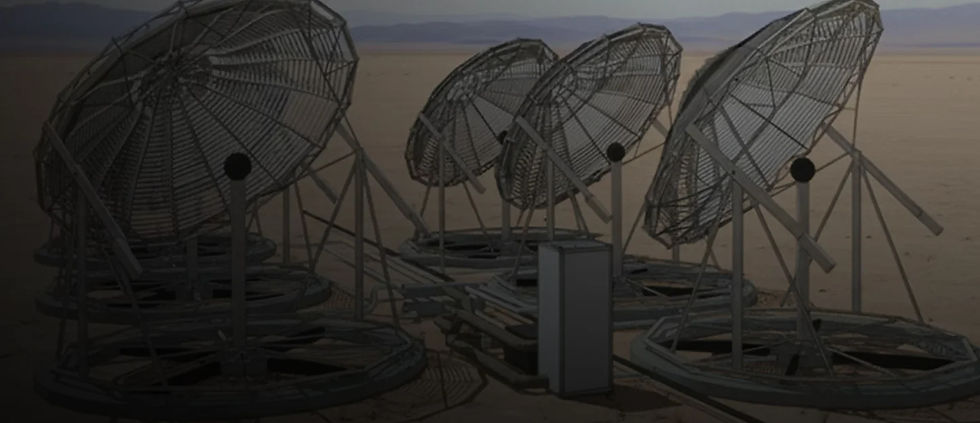
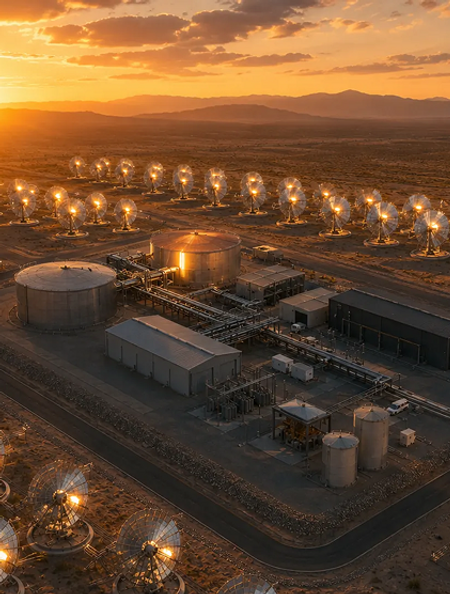
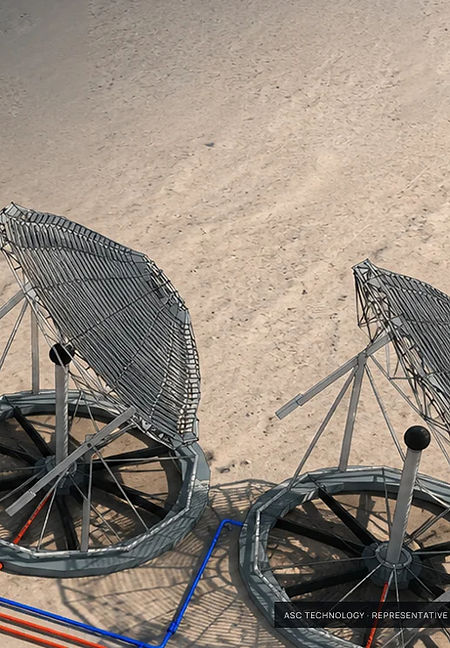
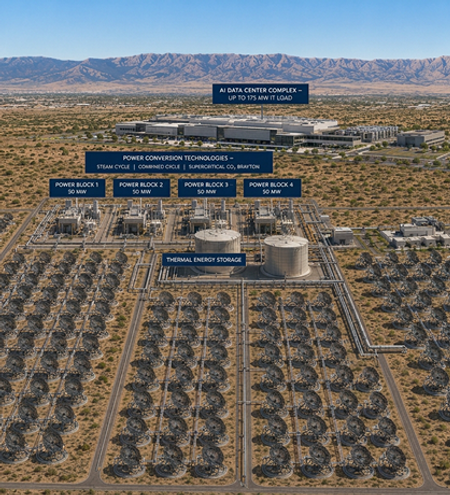
The Solis ASC concentrated solar platform captures high-temperature thermal energy for electricity generation, storage and applications.
Unlike intermittent generation, the Solis platform is designed to provide scheduled and dispatchable energy after sunset and during periods of peak demand.
Modular ASC solar-thermal generation
Long-duration thermal energy storage
Steam, combined-cycle and supercritical CO2-compatible power systems
Behind-the-meter power delivery
Grid-connected or island-capable configurations
Supplemental generation and emergency-power integration
Phased capacity expansion
02 — AI CAMPUS INFRASTRUCTURE
Coordinated energy and digital-infrastructure development.
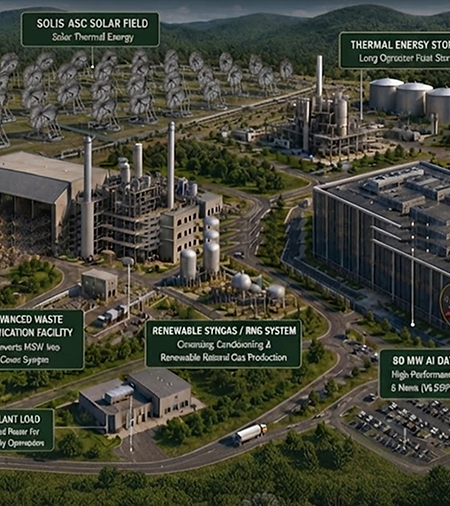
Designed as a holistic ecosystem rather than standalone facility contracts, merging power dispatch directly with compute loads.
Dedicated generation and thermal storage
Data-center buildings or modular compute systems
High-density rack infrastructure
Liquid-cooling and warm-water thermal loops
Grid-import and export capability
Black-start and island-mode operation
Water-efficient heat-rejection systems
Cybersecure microgrid controls
Phased tenant expansion
Dedicated substations and electrical distribution
Waste-heat recovery and productive thermal reuse
03 — FLEXIBLE COMPUTE OPERATIONS
Intelligent triage across priority queues and workload tiers.
We differentiate mission-critical inference, real-time commercial workloads, model training, batch processing, scientific computing, and deferrable workloads to protect uptime and optimize dispatch.
Workload shifting
Controlled load ramping
Demand-response participation
Energy-aware compute scheduling
Thermal-state-aware operations
Prioritized backup-power allocation
Grid-support service participation
.png)
04 — THERMODYNAMICALLY OPTIMIZED AI INFRASTRUCTURE
Thermodynamic optimization based on entropy-generation minimization and exergy optimization.
Improving useful computing output while aggressively reducing avoidable electrical and conversion losses across cooling, transport, and dispatch layers.
Dedicated generation and thermal storage
Compute availability per unit of infrastructure
Reduced cooling and conversion losses
Improved equipment utilization
Recovered and reused thermal energy
Lower infrastructure cost per unit of useful AI output
STANDARDIZED SCALE
STANDARDIZED SOLIS AI CAMPUS CONFIGURATIONS
Solis AI campuses are planned around four standardized capacity classes.
25
MW
Edge / specialized AI campus
Designed for:
Regional inference capacity.
Government and research computing.
Enterprise AI.
Modular cloud infrastructure.
Initial AI-campus demonstrations.
High-value industrial computing.
Typical characteristics:
Rapid phased deployment.
Modular compute blocks.
Behind-the-meter energy.
Option al grid interconnection.
Expansion pathway to 50 MW or greater.
50
MW
Dedicated AI Infrastructure Campus
Designed for:
AI-cloud providers.
Enterprise training and inference.
Sovereign or institutional compute.
Research and advanced simulation.
Regional hyperscale expansion.
Typical characteristics:
Dedicated generation and storage.
Multi-building data-center design.
Redundant electrical architecture.
Flexible workload controls.
Expansion pathway to 100 MW.
100
MW
Hyperscale AI Campus
Designed for:
Large-scale model training.
Hyperscaler capacity expansion.
National AI infrastructure.
Dedicated AI factories. High-density accelerator deployments.
Typical characteristics:
Utility-scale ASC and TES infrastructure.
Multiple compute halls. Dedicated substation and microgrid.
High-capacity liquid cooling.
Grid-support and demand-management capabilities.
Phased delivery of power and compute capacity.
200
MW
Integrated AI Energy Campus
Designed for:
Hyperscale AI clusters.
Multi-tenant AI-cloud infrastructure.
National or sovereign computing platforms.
Large-scale research and scientific computing.
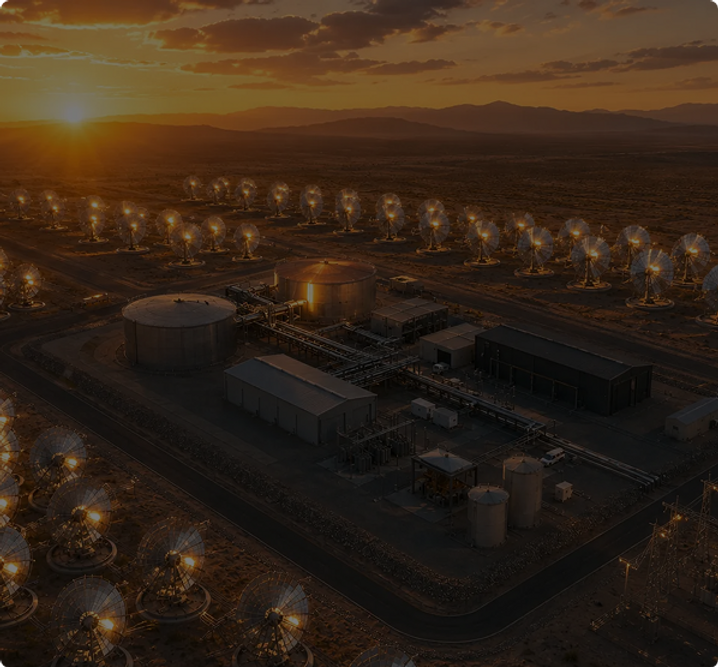
Integrated generation, storage and digital infrastructure.
Typical characteristics:
Multiple power-generation blocks.
Long-duration storage.
Redundant power-conversion systems.
Dedicated transmission and grid interface.
Advanced campus-wide microgrid controls.
Multiple tenant or compute zones.
Expandable development footprint.
Potential integration of steam, combined-cycle and supercritical CO2 power technologies.
PLATFORM UNIFICATION
BRING YOUR OWN POWER
Energy and Compute Developed as One Platform
The conventional data-center development model often separates the facility from the infrastructure required to power it. Solis AI uses a Bring-Your-Own-Power approach.
The result is a defined block of AI capacity with a corresponding plan for generation, storage, resilience and expansion.
01 — DISPATCHABLE ENERGY
Site control
Energy-resource assessment
ASC and TES system design
Campus master planning
Grid and interconnection strategy
Data-center infrastructure
Cooling and water systems
Tenant capacity reservations
Project financing
Phased construction and commissioning
SERVICE SCOPE
MORE THAN ELECTRICITY
A Solis AI Campus can provide a coordinated package of infrastructure services.
Energy Services
Reserved power capacity
Metered energy delivery
Long-duration thermal storage
Peak-energy management
Backup and emergency supply
Renewable-energy attributes
Resilience Services
Island-capable microgrid operation
Black-start capability
Energy reserves
Redundant power-conversion pathways
Supplemental emergency generation
Prioritized restoration of critical loads
Campus Services
Site development
Electrical infrastructure
Water and cooling design
Tenant-specific engineering
Modular expansion
Infrastructure operations and monitoring
Grid Services
Demand response
Controlled load reduction
Ancillary services
Capacity support
Modular expansion
Energy export
Flexible-compute participation
SYSTEM UPTIME
DESIGNED FOR HIGH AVAILABILITY
AI infrastructure requires more than an annual energy calculation.
Solis AI designs reliability across multiple layers:
Solar thermal generation.
Thermal energy storage.
Power-conversion equipment.
Grid connections.
Supplemental generation.
Electrical distribution.
Campus microgrid controls.
Tenant-level backup systems.
Availability commitments would be established for each project based on its complete architecture, point of delivery and customer requirements.
Enhanced-reliability configurations may include:
N+1 or greater equipment redundancy.
Multiple power blocks.
Dual utility feeds.
Dedicated stored-energy reserves.
Emergency generation.
Island-mode operations.
Black-start capability.
Segregated critical and flexible compute loads.

THERMODYNAMIC BALANCE
ENERGY, COOLING AND COMPUTE AS ONE SYSTEM
AI infrastructure produces concentrated heat while consuming large amounts of electricity. Solis AI is designed to coordinate both sides of that equation.
This integrated approach can reduce the amount of energy spent moving and rejecting heat while creating opportunities to use thermal energy productively.
Direct-to-chip liquid cooling
Warm-water cooling
Variable-speed fluid systems
Thermal-gradient management
Waste-heat recovery
Thermal storage integration
Absorption cooling
Desalination and water treatment
Adjacent industrial heat use
Building or district-energy applications
DEVELOPMENT FRAMEWORK
PROJECT DEVELOPMENT MODEL
Each Solis AI project advances through a controlled development process.
Phase 1
Opportunity Definition
Customer load requirements.
Target campus capacity.
Site and geographic screening.
Energy-resource analysis.
Preliminary commercial structure.
Phase 2
Feasibility and Site Control
Site selection.
Power and thermal modeling.
Cooling and water strategy.
Grid and interconnection assessment.
Preliminary campus layout.
Phase 3
Engineering and Commercial Development
Front-end engineering.
Power-system configuration.
Tenant capacity reservation.
Energy and capacity contracting.
Permitting and environmental work.
Financial-model development.
Phase 4
Institutional Readiness
Independent engineering.
EPC validation. Insurance review.
Legal and contractual review.
Project-finance structuring.
Trustee and capital-control architecture.
Phase 5
Construction and Commissioning
Site preparation.
Phased power-block deployment.
Data-center construction.
Electrical and cooling integration.
System testing.
Tenant commissioning.
Phase 6
Operations and Expansion
Energy and campus operations.
Performance monitoring.
Flexible-compute coordination.
Capacity expansion.
Additional tenant deployment.
Grid-service participation.
SYSTEM UPTIME
DESIGNED FOR HIGH AVAILABILITY
AI infrastructure requires more than an annual energy calculation.
Solis AI designs reliability across multiple layers:
Solar thermal generation.
Thermal energy storage.
Power-conversion equipment.
Grid connections.
Supplemental generation.
Electrical distribution.
Campus microgrid controls.
Tenant-level backup systems.
Availability commitments would be established for each project based on its complete architecture, point of delivery and customer requirements.
Enhanced-reliability configurations may include:
N+1 or greater equipment redundancy.
Multiple power blocks.
Dual utility feeds.
Dedicated stored-energy reserves.
Emergency generation.
Island-mode operations.
Black-start capability.
Segregated critical and flexible compute loads.
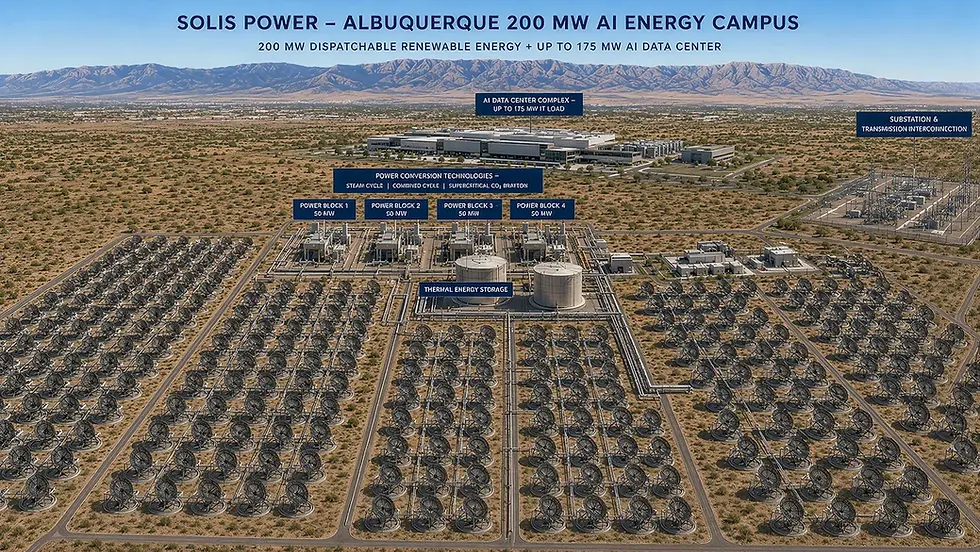
ALBUQUERQUE, NEW MEXICO 200 MW AI ENERGY CAMPUS
POWER PLATFORM
200 MW
AI LOAD
Up to 175 MW
ARCHITECTURE
ASC + TES + power conversion
INFRASTRUCTURE
Dedicated generation + AI campus + grid interconnection
SOLIS AI ENERGY CAMPUS
.png)